5 Steps to the Perfect Piping Layout Using Prevost Piping System (PPS)
Is your compressed air system costing you money?
If your air lines are suffering from pressure drops, moisture buildup, or lack of airflow at the far end of your shop, the problem likely isn’t your compressor—it’s your piping layout. A poorly designed network acts like a bottleneck, strangling the efficiency of even the most powerful compressors.
The Prevost Piping System (PPS) is engineered to solve these problems with its 100% aluminum, smooth-bore construction. However, even the best pipe needs a smart layout to function correctly. In this guide, we will walk you through exactly how to design a PPS layout that maximizes flow, eliminates leaks, and makes future expansion a breeze.
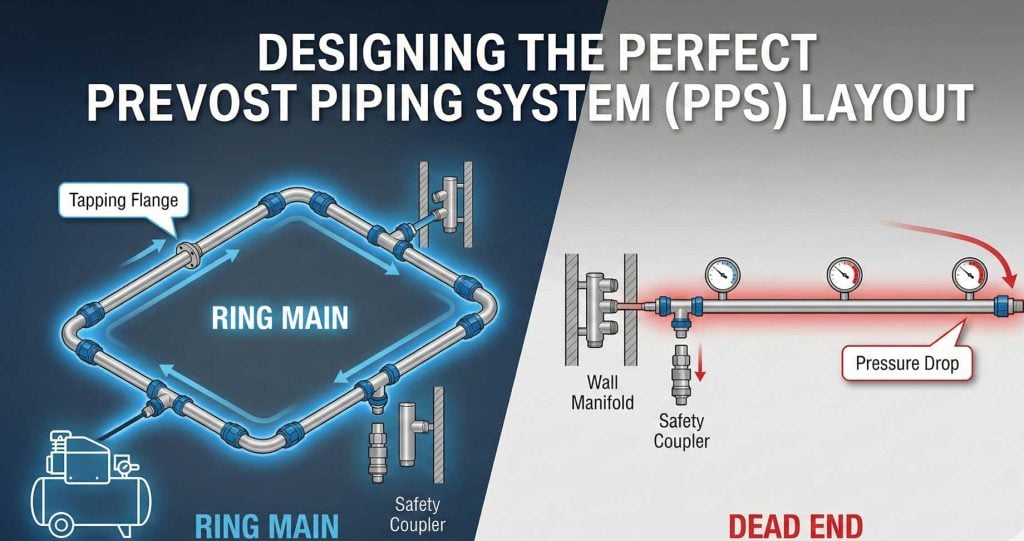
- The Foundation: “Ring Main” vs. “Dead End”
The single most important decision you will make is the geometry of your main line.
Avoid the “Dead End” (Linear)
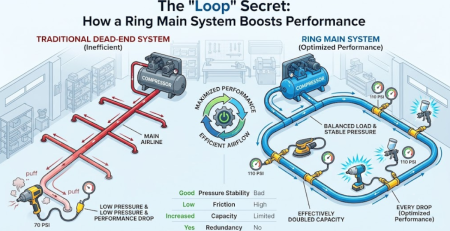
In a linear system, air travels from the compressor to the end of a straight pipe. The stations at the end of the line suffer from significant pressure drop because the air has to fight friction all the way down the pipe. If a high-demand tool (like a 1-inch impact wrench or sandblaster) activates at the start of the line, it starves everything downstream.
Build a “Ring Main” (Loop)
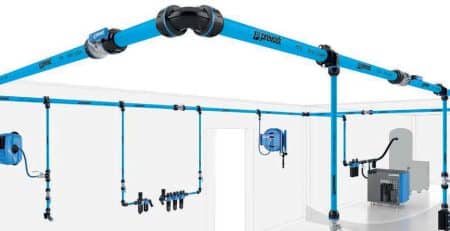
The gold standard for Prevost installations is the closed loop or “Ring Main.” By running your main pipe around the perimeter of your shop and connecting it back to the start, you create a circuit.
Why the Loop wins:
- Balanced Pressure: Air flows to every tool from two directions simultaneously, cutting the distance air travels in half and virtually eliminating pressure drop.
- Constant Supply: Heavy usage in one corner of the shop won’t starve tools in the opposite corner.
- Easy Maintenance: With strategic isolation valves, you can service part of the loop without shutting down the entire plant.
Pro Tip: Start your build with the right foundation. Browse our Prevost Aluminum Pipe to see the 16mm to 100mm diameter options available for your main loop.
- Sizing Your Pipe Correctly
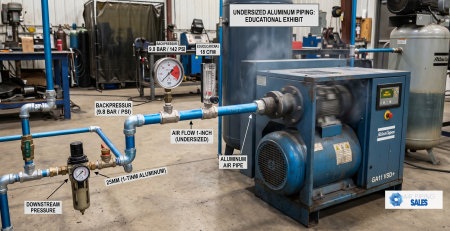
Undersized piping is the silent killer of pneumatic efficiency. Velocity is the enemy; if air moves too fast, friction increases, and pressure drops.
Prevost PPS aluminum pipe offers a significant advantage over steel or black iron because of its ultra-smooth, low-friction inner coating. However, you still need the right diameter.
General Sizing Rules (at 100 PSI):
- 20mm (3/4″): Good for very small loops or individual drops.
- 25mm (1″): Ideal for garages and small workshops (up to ~30 CFM).
- 40mm (1.5″): The standard for medium industrial shops (up to ~100 CFM).
- 63mm (2.5″) & Up: Required for large industrial plants and heavy flow.
Need specific fittings to match these sizes? Check our Prevost Aluminum Fittings section for elbows, tees, and reducers.
- Managing Thermal Expansion
Aluminum expands and contracts with temperature changes. If you bolt a rigid loop of aluminum pipe to your walls in the winter, it might bow or warp in the summer heat.
The Prevost system is rigid, so you must design flexibility into the layout.
The Solution: For long straight runs (over 50 meters/160 feet), or runs crossing building expansion joints, you must install an expansion kit. This is typically a “U” shape loop or a specialized flexible hose section that absorbs the movement of the metal.
- Calculation: Aluminum expands roughly 0.024mm per meter per °C.
- Installation: Use Prevost PPS Piping Clips that allow the pipe to slide (gliding clips) rather than locking it rigidly in place everywhere.
- The Drop Legs: Getting Air to the Floor
The “Drop” is the vertical pipe that brings air from your ceiling loop down to your workbench. How you connect this drop to the main loop is critical for air quality.
The Old Way: The Gooseneck
Traditionally, you had to install a “gooseneck” (pipe curving upwards before going down) to prevent condensation in the main line from flowing into your tools. This was difficult to install and bulky.
The Prevost Way: The Tapping Flange
Prevost revolutionized this with the PPS1 Tapping Flange.
This ingenious fitting bolts directly onto the side of your main pipe. It draws air from the center of the pipe rather than the bottom. This means any moisture or debris traveling along the bottom of the main pipe flows right past your drop, keeping your tools dry.
- Zero Cutting Required: You don’t need to cut the main pipe to add a drop. You simply drill a hole using the flange as a guide.
- Rapid Install: Ideal for adding new workstations to an existing system.
View our Prevost Aluminum Tapping Flanges to see how they fit your system.
- Termination: Manifolds and Couplers
At the bottom of your drop leg, you need a way to plug in your tools. Avoid leaving just a ball valve or a bare pipe end.
Wall Manifolds: Install a Prevost Wall Manifold (typically a 2-port or 3-port block). These allow you to mount your couplers securely to the wall or beam, protecting the pipe from being yanked by operators pulling on air hoses.
Safety Couplers: Finish the system with PrevoS1 Safety Couplers. These push-button couplers depressurize the hose before disconnection, preventing the dangerous “hose whip” that causes so many shop injuries.
Summary Checklist for Your Design
- Draft a Loop: Draw a ring main around your facility rather than a straight line.
- Size Up: When in doubt, go one pipe size larger for the main loop to future-proof your flow.
- Slope It: Install the main loop with a slight slope (1%) toward a low point.
- Drain It: Install a drop leg with a valve or automatic drain at that low point to remove moisture.
- Use Tapping Flanges: Save time and protect tools by drawing dry air from the side of the pipe.
Ready to Build?
We stock the complete line of Prevost piping, from the massive 80mm mains to the essential clips and cutters.
Start Building Your Quote Here or contact our team for help sizing your specific layout.
Compressed Air Piping
Undersized Compressed Air System: 5 Signs
5 Signs Your Compressed Air System is Undersized (And How to Fix It)In the world of manufacturing, a compressed...
Compressed Air Piping
Aluminum Piping vs. Black Iron: Best Compressed Air?
Aluminum vs. Black Iron: Why Your Piping Material Choice is Killing Your ToolsWhen setting up a compressed air system, most...
Compressed Air Piping, Fluid Distribution, Prevost How To
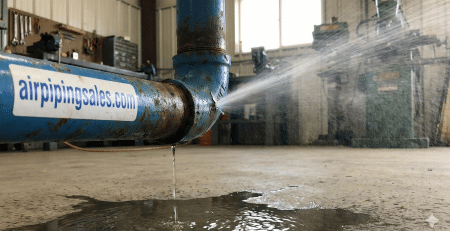
Addressing Costly Air Leaks
How Much Are Your Air Leaks Actually Costing You?Often times the "hiss" of a compressed air leak blends into the...
Prevost How To, Compressed Air Piping
Care Guide for Prevost Piping Systems
Care Guide for Prevost Piping SystemsWhen you choose a Prevost Piping System, you aren't just buying pipe—you are investing in...
Prevost How To
How to Connect and Disconnect Prevost Couplers
How to Connect and Disconnect Prevost Couplers: Master Your Air ToolsIf you have spent any time in a professional shop,...