How Much Are Your Air Leaks Actually Costing You?
Often times the “hiss” of a compressed air leak blends into the background during operation. It’s easy to ignore; it’s just air, right?
But that silence is deceptive. In the world of industrial maintenance, that faint whistling sound is actually the sound of money escaping your bottom line. Compressed air is one of the most expensive utilities in a plant, and if you aren’t managing your air leaks, you’re essentially paying for energy just to vent it into the atmosphere.
The Hidden Price Tag
Compressed air is often called the “fourth utility,” but unlike water or electricity, we generate it on-site. Which can make it easy to underestimate its cost.
To give you an idea, consider this: A single 1/4-inch leak in a compressed air line at 100 psi can cost a facility upwards of $2,000 to $6,000 per year.
Now, multiply that by dozens of smaller air leaks across a sprawling network of pipes, valves, and connectors. In many plants, 20% to 30% of total compressor capacity is lost to leaks. If you’re running a 100-hp compressor, you might be spending $15,000 a year just to power the leaks.
Why Leaks Are More Than Just an Energy Bill
The financial drain doesn’t stop at your utility bill. Leaks create a “trickle-down” effect of inefficiency throughout your entire operation:
Artificial Demand: Leaks force your compressors to run harder than necessary to maintain system pressure.
Decreased Tool Life: When pressure drops due to leaks, pneumatic tools and machines operate less efficiently, leading to increased wear and tear.
Increased Maintenance: Running compressors “overtime” to compensate for leaks shortens the intervals between expensive service overhauls.
Production Downtime: In extreme cases, massive leakage can cause system pressure to drop so low that production equipment fails or cycles incorrectly, leading to scrapped parts.
How to Find and Fix the “Whistle”
The good news? Fixing air leaks is easier than you think. Here is how to get started:
| Method | Description | Pros/Cons |
|---|---|---|
| The “Ear” Test | Walking the floor during a weekend or quiet shift to listen for hissing. | Cost-effective but misses smaller, high-frequency leaks. |
| Soapy Water | Spraying connections with a soap solution to look for bubbles. | Very accurate for specific joints; time-consuming for large plants. |
| Ultrasonic Detection | Using a specialized device that “hears” the high-frequency sound of escaping air. | Gold Standard. Finds leaks from a distance even in noisy environments. |
Making the Change
The goal shouldn’t just be a one-time “leak hunt.” Successful facilities implement a Leak Management Program. This involves tagging leaks as they are found, prioritizing them by size, and verifying the repair.
By turning down the volume on your leaks, you aren’t just making the plant quieter—you’re making your business significantly more profitable.
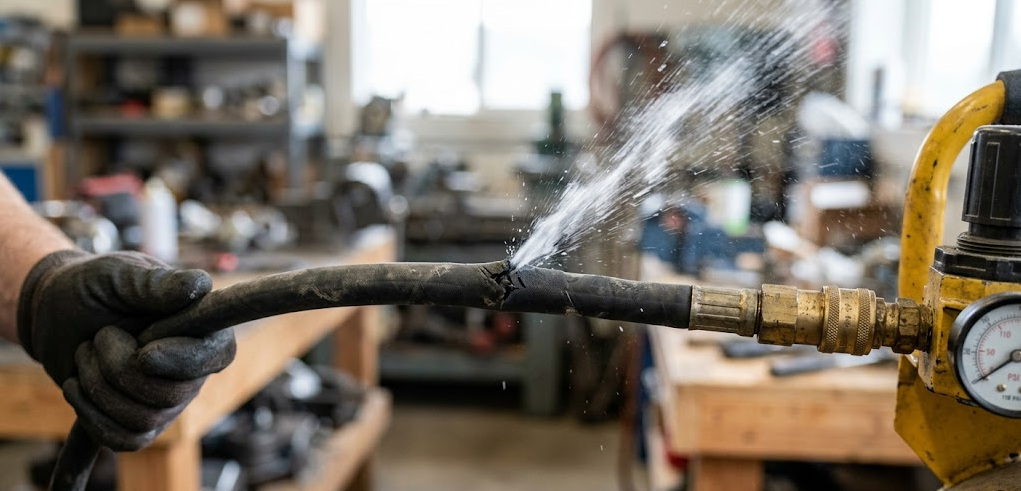
Pro Tip: Don’t forget the “point of use.” While most people look at the main headers, the majority of leaks occur at the end of the line: in degraded hoses, cheap quick-disconnects, and worn-out filters.
Compressed Air Piping
Undersized Compressed Air System: 5 Signs
5 Signs Your Compressed Air System is Undersized (And How to Fix It)In the world of manufacturing, a compressed...
Compressed Air Piping
Aluminum Piping vs. Black Iron: Best Compressed Air?
Aluminum vs. Black Iron: Why Your Piping Material Choice is Killing Your ToolsWhen setting up a compressed air system, most...
Prevost How To, Compressed Air Piping
Care Guide for Prevost Piping Systems
Care Guide for Prevost Piping SystemsWhen you choose a Prevost Piping System, you aren't just buying pipe—you are investing in...
Prevost How To, Compressed Air Piping
5 Steps to the Perfect Prevost Piping System (PPS) Layout
5 Steps to the Perfect Piping Layout Using Prevost Piping System (PPS)Is your compressed air system costing you money?If your...
Fluid Distribution
More Than Just Hot Air
More Than Just Hot Air: Why Prevost Blow Guns Are the Industry Standard for Safety and EfficiencyIn any industrial workshop,...
Prevost How To
How to Connect and Disconnect Prevost Couplers
How to Connect and Disconnect Prevost Couplers: Master Your Air ToolsIf you have spent any time in a professional shop,...