Aluminum vs. Black Iron: Why Your Piping Material Choice is Killing Your Tools
When setting up a compressed air system, most people obsess over the compressor. They research horsepower, CFM, and tank size, but then they make a fatal mistake: they treat the piping as an afterthought.
If you’re still using traditional black iron pipe to move your air, you aren’t just dealing with a heavy installation, you are actively degrading every pneumatic tool at the end of the line. Here is why the “old school” way is costing you a fortune in tool repairs.
The Silent Killer: Internal Corrosion
The biggest enemy of your air tools isn’t heavy use; it’s moisture. Compressed air inherently contains water vapor. In a black iron system, that moisture reacts with the raw metal to create internal scaling and rust.
- Black Iron: Over time, flakes of rust and pipe scale break off and travel through the line. These abrasive particles act like liquid sandpaper, grinding down the internal seals and vanes of your expensive impact wrenches and grinders.
- Aluminum: Aluminum is naturally corrosion-resistant. The air stays as clean as it was when it left the dryer, ensuring your tools are only “breathing” air, not debris.
The Roughness Factor (And Why It Matters)
It isn’t just about dirt; it’s about physics. The interior of a black iron pipe is naturally rough, and that roughness increases as it ages and rusts. This creates friction, which leads to pressure drop.
When you have a significant pressure drop, your tools don’t get the energy they need to perform. You might think your tool is “dying,” but in reality, it’s just starving for air. To compensate, many shops crank up the compressor pressure, which uses more energy and puts even more strain on the system—a vicious cycle.
Comparison: At a Glance
| Feature | Black Iron Pipe | Aluminum Piping |
|---|---|---|
| Corrosion | High (Rust & Scaling) | None |
| Internal Air Quality | Poor (Contaminated) | High (Clean) |
| Weight | Very Heavy | Lightweight |
| Installation Speed | Slow (Threading/Cutting) | Fast (Push-to-connect) |
| Leak Potential | High (Threaded joints) | Low (Engineered seals) |
Why Aluminum is the “Tool-Saver”
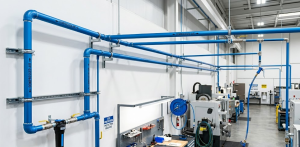
Switching to an aluminum piping system- like those from Prevost– offers three immediate benefits for your tool crib:
- Consistent Pressure: The smooth bore of aluminum pipe means minimal friction. Your tools get the exact PSI they were designed for.
- No “Gunk”: Without rust flakes entering the airstream, your FRLs (Filter-Regulator-Lubricators) don’t get clogged every other week, and your tool’s internal valves stay pristine.
- Modular Flexibility: If you need to add a drop or move a machine, aluminum systems are modular. You don’t need a threading machine and a gallon of pipe dope; you just need a hex key and a pipe cutter.
The Bottom Line
Black iron might be cheaper at the hardware store per foot, but when you factor in the labor of installation, the energy loss from friction, and the replacement cost of ruined air tools, it is the most expensive choice you can make.
If you want your tools to last a decade instead of a year, stop feeding them rust. It’s time to look at aluminum.
Ready to Upgrade Your Shop’s Piping System?
Choosing the right compressed air setup can be overwhelming, but you don’t have to figure it out alone. Designing a system that protects your tools and maximizes efficiency requires planning out the right drops, layout, and material sizes. For more information, or if you have questions about transitioning your shop from black iron to aluminum, reach out to our team here. Our compressed air experts are ready to help you build a clean, rust-free system that keeps your tools running like new for years to come.